

窒息:5个常见误区及你真正需要了解的事实
28 October 2026

Someone is choking. You rush to help. But do you really know what to do?
Choking can turn an ordinary moment into a life-threatening emergency in seconds. Yet, despite how common it is, many of us are unsure how to respond. Should we slap their back? Give them water? With so much conflicting advice out there, it's easy to get confused — and doing the wrong thing could make matters worse!
The Accident & Emergency (A&E) team at Sunway Medical Centre, Sunway City, cuts through the confusion, busting five common choking myths and showing you what really works when every second counts.
When Does Choking Happen?
Choking occurs when food or another foreign object partially or completely blocks the airway, making it difficult or impossible to breathe.
Although choking can happen to anyone, certain situations increase the risk:
- Eating too quickly or without chewing properly
- Talking or laughing while eating
- Children playing or running with food in their mouths
- Eating foods that are difficult to chew or swallow, such as whole grapes, fish balls, bubble tea pearls or other large, round food items
- Feeding infants while lying flat, or leaving them unattended with a propped milk bottle, which may increase the risk of choking or milk aspiration
Young children, older adults and people with swallowing difficulties are particularly vulnerable.
How to Recognise a Choking Incident
Choking is not always obvious. While some people may cough or struggle to breathe, others may be unable to make any sound at all.
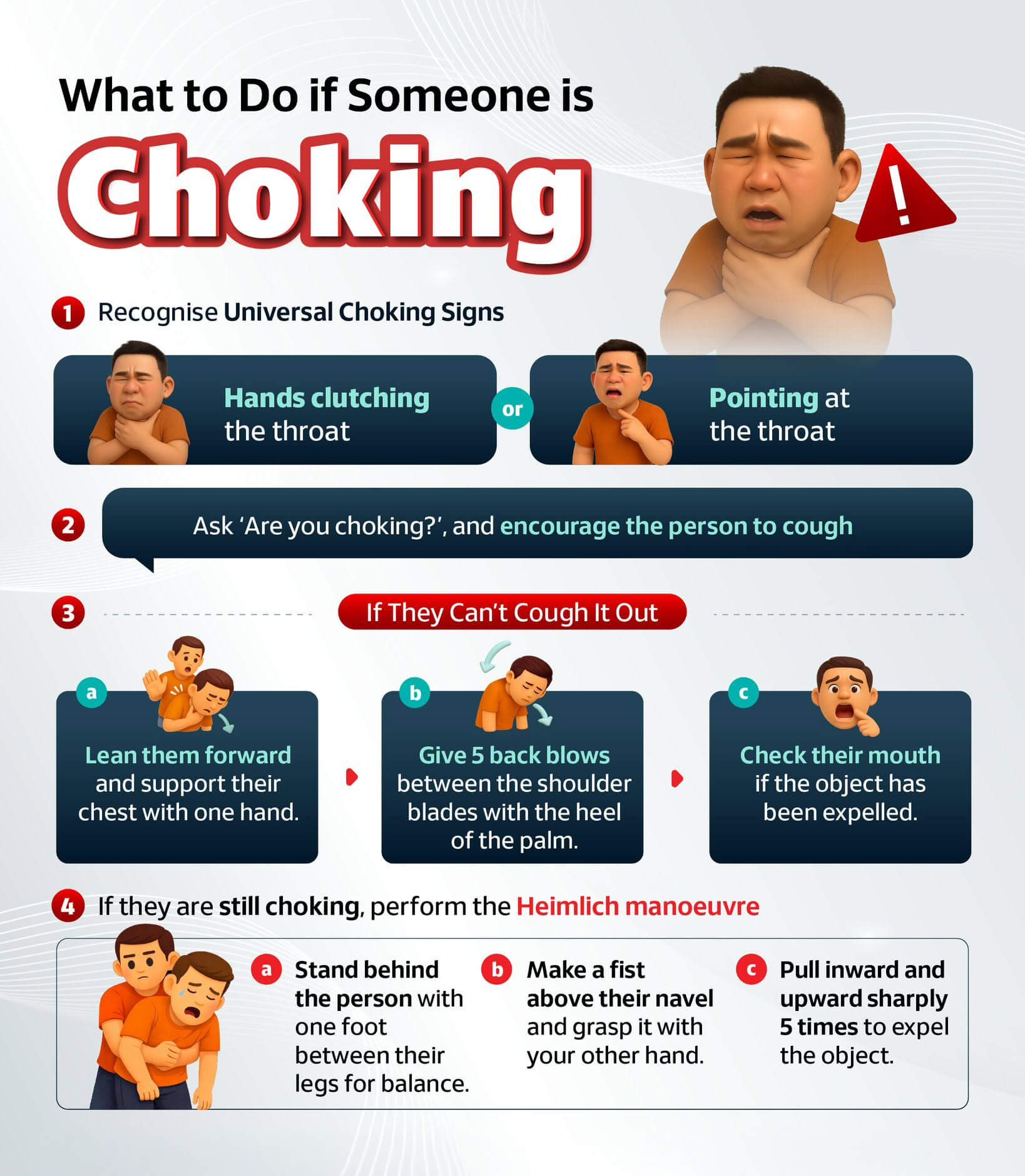
One of the most recognisable signs is the universal choking sign — clutching the throat with one or both hands.

However, not everyone who is choking will display this sign. Other warning signs include:
- Difficulty breathing or noisy breathing
- Inability to speak or make sounds
- Weak or ineffective coughing
- Bluish discolouration of the lips or skin in severe cases
- Loss of consciousness if the obstruction is not relieved
Remember: Severe choking can be silent. A person who cannot speak, breathe or cough effectively may have a completely obstructed airway.
5 Common Choking Myths & Facts
With so much conflicting advice, it's easy to mistake a common misconception for the right first-aid technique. Let's separate fact from fiction.
Myth 1: Hitting or slapping on the person’s back will push the object out of the mouth.
Fact: Not necessarily! Back blows can be effective, but only when performed correctly and in the right circumstances.
If someone is still able to cough effectively, encourage them to keep coughing. Unnecessary back blows may interfere with their efforts to clear the obstruction and worsen the situation.
However, if the person cannot breathe, speak or cough effectively, properly delivered back blows can help dislodge the object.
Remember: The key is knowing when and how to give back blows, rather than simply hitting someone on the back.
Myth 2: The Heimlich manoeuvre is the only way to help someone who is choking.
Fact: There is no single choking first-aid technique that works for everyone. The appropriate technique depends on the person's age and condition.
For adults and children over one year old, severe choking is managed using a combination of back blows and abdominal thrusts (commonly known as the Heimlich manoeuvre).
However, infants under one year old require a different approach, using back blows and chest thrusts instead. Abdominal thrusts should never be performed on infants because of the risk of internal injury.
For pregnant women in late pregnancy or individuals for whom abdominal thrusts are impractical, chest thrusts are recommended instead.
Myth 3: Choking only happens to young children.
Fact: Choking can happen to anyone, regardless of age!
While young children are particularly vulnerable because of their smaller airways and tendency to put objects into their mouths, adults are not immune.
Older adults and individuals with swallowing difficulties, neurological conditions or poorly fitting dentures may also be at increased risk.
The bottom line? Choking can happen to anyone, so everyone should know how to recognise it and respond appropriately.
Myth 4: Drinking water or swallowing food can push a choking object down and clear the blockage.
Fact: It depends on the situation!
We've all experienced that sudden coughing episode when food or water goes down the wrong way. Our natural reaction is often to reach for a glass of water to soothe the throat.
But there's an important difference between coughing because something has irritated the airway versus choking because something is blocking it.
- Food passage (oesophagus): The oesophagus carries food and liquid to the stomach. Food may sometimes feel stuck here without affecting breathing.
- Airway (trachea): The trachea carries air to the lungs. When food or another object blocks this passage, breathing can become difficult or impossible.
If someone is coughing effectively, encourage them to keep coughing rather than giving them water. Once the coughing has settled and they can breathe and swallow normally, a sip of water may help soothe the throat.
However, if someone cannot breathe, speak or cough effectively, never give them water. This is a choking emergency that requires immediate first aid.
Remember: Water may soothe an irritated throat, but it cannot clear a blocked airway.
Myth 5: Using your fingers to remove a choking object can help clear the airway.
Fact: Never perform a blind finger sweep. Putting your fingers into someone's mouth without clearly seeing the object may push it deeper into the airway, making the obstruction worse.
If an object is clearly visible in the mouth and can be easily reached, it may be carefully removed. However, do not attempt to reach deep into the throat or blindly search for the object.
Remember: If you can't see it, don't sweep it!
What to Do When Someone Is Choking
When someone is choking, every second counts. Knowing what to do can help you respond quickly and effectively.
Step 1: Stay Calm and Assess the Situation
Stay calm, but act quickly. Check whether the person can still breathe, speak or cough.
- If they can cough effectively: Encourage them to keep coughing. There is no need to slap their back or perform abdominal thrusts. Stay with them and monitor their condition.
- If they cannot breathe, speak or cough effectively: This indicates severe choking. Begin choking first aid immediately and ask someone to call 999.
Step 2: Give Up to Five Back Blows
If the person cannot breathe, speak or cough effectively, give back blows to help dislodge the obstruction.
For adults and children over one year old:
- Stand: Stand behind the person
- Lean forward: Support their chest with one hand and help them bend forward
- Give a back blow: Use the heel (bottom part) of your other hand to give a firm blow between their shoulder blades
- Check and repeat: Check if the object has come out. If not, repeat up to five times
If the obstruction remains after five back blows, proceed to abdominal thrusts.
If the person is still choking after five back blows, perform abdominal thrusts to help push the object out.
For adults and children over one year old:
- Stand: Stand behind the person and wrap both arms around their waist
- Make a fist: Place your fist just above their belly button, below the rib cage
- Hold your fist: Grasp your fist with your other hand
- Pull in and up: Give a quick, firm pull inwards and upwards
- Check and repeat: Check if the obstruction has cleared. If not, repeat up to five times
If the person is still choking, continue alternating five back blows and five abdominal thrusts until the obstruction clears or the person becomes unresponsive. Ensure someone has called 999.
Do not perform abdominal thrusts on infants under one year old. They require a different first-aid technique.
Step 4: What If a Baby Is Choking?
Babies under one year old need a different approach. Never perform abdominal thrusts on a baby.
If the baby cannot breathe, cry or cough effectively:
- Position the baby: Lay the baby face down along your forearm or thigh, supporting their head and neck. Keep their head lower than their body.
- Give five back blows: Using the heel of your hand, give up to five firm blows between the baby's shoulder blades. Check after each blow.
- Turn the baby over: If the obstruction remains, carefully turn the baby face up, continuing to support their head and keeping it lower than their body.
- Give five chest thrusts: Using the heel of one hand, give up to five quick, firm downward thrusts in the centre of the baby's chest, over the lower half of the breastbone.
- Repeat if necessary: Alternate five back blows and five chest thrusts until the obstruction clears or the baby becomes unresponsive.
Ask someone to call 999 immediately. If you are alone, call 999 on speakerphone while providing first aid.
Step 5: What If the Person Becomes Unconscious?
Sometimes, a person may lose consciousness while you are giving back blows or abdominal thrusts.
If this happens, stop immediately and switch to CPR.
- Lower them to the ground: Gently lay the person on their back on a firm, flat surface.
- Call 999: If no one has called for help, call 999 immediately and put your phone on speaker.
- Start CPR: Begin chest compressions in the centre of the chest. Follow the emergency operator's instructions.
- Check the mouth: Before giving rescue breaths, look inside the mouth. Remove an object only if it is clearly visible and easy to reach. Never blindly sweep your fingers inside.
Continue CPR until the person starts breathing normally or emergency medical help takes over.
Step 6: Seek Medical Attention After a Choking Incident
Even if the obstruction has been successfully cleared, medical attention may still be necessary.
- If abdominal or chest thrusts were performed: Seek medical assessment, as these manoeuvres can sometimes cause internal injuries.
- If symptoms persist: Difficulty swallowing, persistent coughing, chest pain or breathing difficulties may indicate an underlying injury or that the obstruction has not completely cleared.
- If the person lost consciousness: Emergency medical assessment is essential, even if they have regained consciousness.
When Every Second Counts, We're Here to Help
Knowing how to respond during a choking emergency can save a life. Equally important is knowing when and where to seek medical help.
For life-threatening emergencies, call 999 for Malaysia's national emergency response. You may also contact Sunway Medical Centre directly for emergency care or to request our ambulance service.
Our Accident & Emergency (A&E) Department at Sunway Medical Centre, Sunway City, is open 24 hours a day.
EMERGENCY: +603-5566 8888
AMBULANCE: +6019-666 6940


