

Double Balloon Enteroscopy (DBE): A Way Forward for Small Bowel Disease Through Advanced Endoscopy
23 September 2026
_Web.jpg)
The small intestine has traditionally been a "blind spot" for doctors due to its extreme length and complex folds. Many gastrointestinal bleeds or abnormalities remain undetected even after a standard gastroscopy and colonoscopy.
Double Balloon Enteroscopy (DBE) is an advanced, specialised scope procedure designed to bridge this diagnostic gap. Using a unique "push-and-pull" mechanism, Double Balloon Enteroscopy allows specialists to reach deep into the small intestine for both precise diagnosis and immediate therapeutic intervention.
Why is Double Balloon Enteroscopy Performed?
Double Balloon Enteroscopy is primarily used when standard imaging or endoscopy results are inconclusive. Key indications include:
- Obscure Gastrointestinal Bleeding (OGIB): Identifying the source of bleeding when both gastroscopy and colonoscopy results are negative.
- Small Bowel Polyps & Tumours: Facilitating the removal of polyps or performing biopsies and "tattooing" (marking) lesions for future surgical resection.
- Crohn’s Disease: Assessing the extent of inflammation or treating narrowing within the small bowel.
- Follow-Up on Abnormal Imaging: Providing direct visualisation of anomalies detected via capsule endoscopy, CT, or MRI enterography.
How Does Double Balloon Enteroscopy Work?
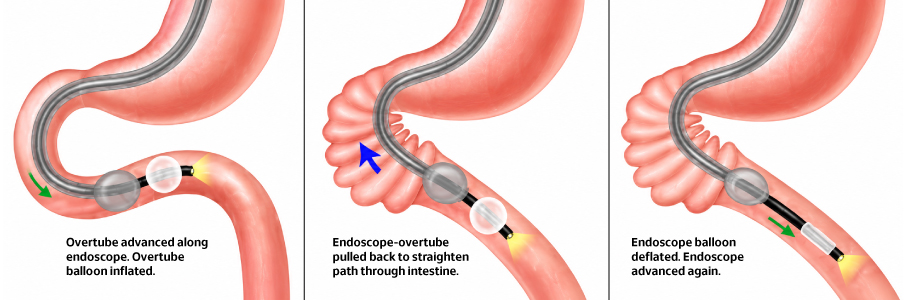
Double Balloon Enteroscopy utilises a high-resolution endoscope equipped with two inflatable balloons: one at the tip of the scope and another on a sliding overtube.
By inflating and deflating these balloons in a sequential "inchworm" fashion, the small intestine is gently pleated over the overtube. This allows the scope to progress much deeper than conventional tools, ensuring a thorough inspection of areas that were previously unreachable.
How Is the Double Balloon Enteroscopy Performed?
Below is an overview of the typical process of a Double Balloon Enteroscopy, covering everything from pre-procedure preparation to what happens during recovery and follow-up care.
- Preparation: The patient undergoes fasting and/or bowel preparation to ensure a clear view.
- Sedation: The procedure is typically performed under general anaesthesia.
- Insertion: The enteroscope is inserted either through the mouth (antegrade) or the anus (retrograde), depending on the suspected location of the issue.
- Intervention: If an abnormality is found, the specialist can immediately perform biopsies, apply clips, use cauterisation to stop bleeding, or remove polyps.
- Recovery: The patient is monitored in recovery bay until the effects of the anaesthesia wear off.
- Follow-up: A clinic consultation is scheduled to discuss the findings and any necessary next steps in the treatment plan.
Advantages of Double Balloon Enteroscopy
Compared to other diagnostic methods, Double Balloon Enteroscopy offers several distinct benefits that allow for more effective diagnosis and treatment of complex conditions in the small intestine. This includes:
- Active Intervention: Unlike capsule endoscopy, which only captures images, Double Balloon Enteroscopy allows for real-time treatment (e.g., biopsy, cauterisation, polypectomy).
- Total Enteroscopy: By combining both oral and anal approaches, specialists can potentially visualise the entire length of the small intestine.
- Stability and Control: The balloon-anchoring system provides a stable platform, allowing for a more detailed and controlled inspection of the intestinal wall.
Expert Care for Small Bowel Disease
For conditions related to the small bowel, choosing the right specialist and facility matters. At Sunway Medical Centre, Sunway City, our gastroenterology team, led by Dr Khoo Stanley, Consultant Gastroenterologist and Hepatologist, combines advanced endoscopic technology with experienced clinical expertise to deliver accurate diagnosis and effective treatment for complex small intestine conditions.
If you're experiencing unexplained gastrointestinal symptoms, suspect small bowel disease, or have been advised to undergo Double Balloon Enteroscopy, our team is here to help you answer your questions and guide you through your options. Click below to schedule a consultation or find out more today.


