

Transcatheter Aortic Valve Replacement (TAVR): A Minimally Invasive Treatment for Severe Aortic Stenosis
28 September 2026
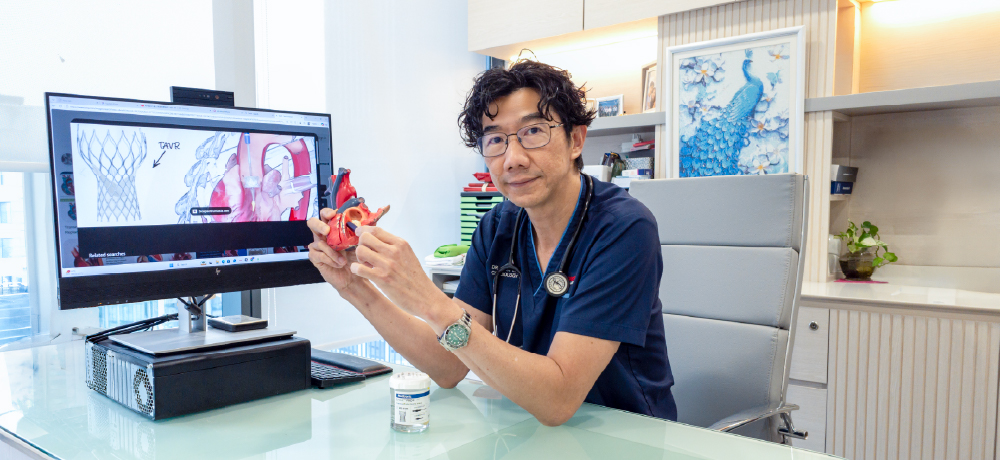
A former colleague from the National Heart Institute referred a patient to me for consultation.
The patient was a 70-year-old woman who had been experiencing shortness of breath during physical activity, chest pain and reduced exercise tolerance. She became breathless after climbing just one flight of stairs. She also experienced mild dizziness and heart palpitations.
Further assessment revealed severe aortic stenosis, the narrowing of the aortic valve, involving a bicuspid aortic valve, as well as mitral and tricuspid valve regurgitation. In simpler terms, the valves do not close completely, causing the blood to flow backwards. This patient also had pulmonary hypertension, which is high blood pressure in the lungs, and advanced heart failure.
An echocardiogram revealed a very poor heart pumping function, with a left ventricular ejection fraction (LVEF) of just 25–30%. For comparison, a normal LVEF is generally above 50%.
Given the severity and complexity of her condition, aortic valve replacement was the only treatment option. However, conventional open-heart surgery, known as surgical aortic valve replacement (SAVR), carried an unacceptably high risk of death during or shortly after surgery. For patients with multiple medical conditions like her, Transcatheter Aortic Valve Replacement (TAVR) offers a minimally invasive alternative, with evidence of improved survival and positive changes in the heart's structure and function, known as cardiac remodelling.
Severe symptomatic aortic stenosis can significantly affect a person's quality of life. Without timely definitive treatment, the prognosis can be poor once symptoms develop.
Communicating with Compassion
I knew that the diagnosis would be difficult for both the patient and her family to hear and accept. It is never easy for a doctor to break bad news to a patient. As such, I took the time to explain her condition in a calm and reassuring manner, while also emphasising the treatment option.
My priority was to help her understand that although she had severe aortic stenosis that was life threatening, there was a treatment option that could improve her symptoms and quality of life. With appropriate treatment and recovery, there was also a possibility that she could return to her usual daily activities.
Why TAVR May Be Considered
Conventional open-heart surgical aortic valve replacement (SAVR) has long been an established treatment for adults with severe symptomatic aortic stenosis.
However, this conventional open-heart surgery may carry greater risks for patients with accompanying medical conditions, including severe heart failure, coronary artery disease, cerebrovascular disease, peripheral artery disease, chronic kidney disease and chronic respiratory conditions.
This patient of mine was at increased risk with conventional surgery. For those with increased surgical risks, TAVR may provide a less invasive, safer and effective treatment option.
The decision between TAVR and surgical aortic valve replacement also depends on several factors, including the patient's age, overall health, surgical risk, valve and vascular anatomy, life expectancy and individual circumstances. A detailed assessment by a multidisciplinary heart team is therefore important in determining the most appropriate treatment approach.
How TAVR Works
Unlike conventional open-heart surgery, TAVR does not require the chest to be opened.
Instead, a replacement valve is delivered to the heart through a thin tube called a catheter, usually through an artery, or blood vessel, in the groin. The new valve is then positioned within the diseased aortic valve, where it takes over the function of the native valve and improves blood flow through the aortic valve.
As such, for appropriately selected patients, TAVR can provide a less invasive alternative to conventional surgical valve replacement.
TAVR for Complex Aortic Valve Disease
The aortic valve normally has three leaflets. However, some people are born with a bicuspid aortic valve (BAV), which has two leaflets instead of three.
People with BAV may develop aortic stenosis at a younger age and have an increased risk of diseases affecting the thoracic aorta.
When TAVR was first introduced, it was primarily used to treat aortic stenosis involving tricuspid aortic valves. With advances in technology, imaging and treatment techniques, TAVR can now also be considered for selected patients with BAV.
However, performing TAVR in patients with BAV can be technically more challenging because of the differences in valve and aortic anatomy, including variations in the shape of the valve and the distribution of calcium. Bicuspid aortic valve disease may also be associated with abnormalities of the aorta.
For these reasons, careful imaging, detailed procedural planning and multidisciplinary assessment are particularly important in determining whether TAVR is appropriate for an individual patient.
What Are the Benefits of TAVR?
As a minimally invasive approach to aortic valve replacement, TAVR avoids the need for a traditional sternotomy, in which the breastbone is opened to access the heart.
For appropriately selected patients, TAVR may offer benefits such as a shorter recovery period and an earlier return to normal activities compared with conventional open-heart surgery.
However, TAVR may not be suitable for every patient. It depends on each patient’s individual condition, valve and vascular anatomy, overall health and surgical risk. The professional heart team will carefully assess these factors before recommending the most appropriate treatment approach for each patient.
Compassion Beyond Treatment
For this patient, TAVR offered a safer and promising treatment option that was better suited to her condition and the risks associated with conventional surgery.
However, I believe that caring for a patient goes beyond finding the right treatment. It also means understanding their concerns, recognising the challenges they and their families face, and supporting them through difficult moments.
I am happy and proud to state that the TAVR procedure for this patient was successfully performed by my team at Sunway Medical Centre, Sunway City, marking an important milestone in the treatment of this complex case of bicuspid aortic stenosis. This case also marked the first TAVR procedure performed for bicuspid aortic stenosis at Sunway Medical Centre, Sunway City.
To me personally, with more than 28 years of clinical experience, this case was a reminder of what it means to practise medicine with compassion — to look beyond the condition that needs to be treated and care for the person and family behind it.
Supporting Every Heart Care Journey
Every patient deserves care that considers not only their medical condition, but also their individual needs and circumstances.
Our multidisciplinary team brings together expertise across different areas to assess each patient's condition and determine the most appropriate treatment options and care for their wellbeing.
If you wish to learn more about TAVR, schedule an appointment with Dr Lim Bee Chian today and find out whether it may be a suitable treatment option for you.


